Accountability Citizenship
Connect with the Author
  • Home
  • Join our Community!
  • Blog
  • Bookstore
  • Contact
  • Book Reviews
  • Spotlight
  • Survey & Chance to Win Book!

We could Have Had an Election between two Governors in 2016...

4/18/2018

0 Comments

 
Picture
Last night, I re-posted a blog from 2015 with my research showing a correlation between prior experience as a governor and above average performance as President of the United States. Tonight, I republish my blog from September 16, 2015, in which I advocated for an election pitting Republican John Kasich (Governor of Ohio) and Democrat Martin O'Malley (Governor of Maryland).

Had we nominated these two candidates, we could have had an election about the issues and the future of our country.  We could have had a President focused on leading the country, instead of one consumed with scandals ranging from adultery to treason.  Why didn't we make the better choice in the last election? How can we choose better in 2020? 

The Election I Want to See... and the One I Don't Want to See9/16/2015
0 Comments

 
The Republicans are having their second televised debate this week, while the Democrats, with a smaller field of candidates, still haven't had their first.  There will be 11 candidates in the main Republican debate this time around. Carly Fiorina has surged into the top ten.  Governor Chris Christie has dropped out of the top ten, but, for some odd reason, CNN has decided to keep him in the main debate.  I think there were rumors all the traffic lights around the CNN building were going to experience "software failures" if Christie didn't keep his spot.  Those darn Iranian hackers are everywhere.  Here are the debate lineups: http://www.vox.com/2015/9/10/9308571/republican-debate-candidates

The point of today's blog is not to emphatically declare I have chosen the candidates for whom I am willing to vote next year.  We are fortunate to have many opportunities ahead to evaluate the candidate field and make our final choices.  But the nominating processes for both major parties generally do not select the candidates I feel would be best for our country--that is part of my frustration with the major party machines.  I think my frustration is shared by many, and explains why 44 percent of registered voters identify themselves as independents. So I want to share my thought process on the current candidate field with you at this early point.  I encourage each of you to consider the candidate you would select from each party if you were to vote today for a candidate from that party.  

Since the Republicans have already had one debate and are about to have another, let's start with them.  I am happy that former Ohio governor and congressman John Kasich is still in the line-up.  He is my preferred Republican candidate at this point for three reasons:  (1) my research shows that former governors are more likely to perform better as president than people without that experience (What Makes A Great President), (2) Kasich was a key player in Congress during the Clinton administration and played an important part in balancing the budget during his tenure as Chairman of the House Budget Committee, and (3) although he has spent most of his life in politics, he has demonstrated the ability to rise above party and interest group pressure to act on his values--a key characteristic of a career citizen.  A Kasich ticket with Fiorina as Vice President would be compelling in my view.  Fiorina is the quintessential career citizen, but I think she needs some experience inside government before she is ready to be President.  Her track record as a senior business executive shows me that she took a while to come up to speed as CEO of Hewlitt Packard, and we can't afford that kind of learning curve in our next Chief Executive.

On the Democratic side, I would like to see Martin O'Malley nominated.  Again, he has the experience of being a governor (What Makes a Great President), and he is more credible than the other Democratic challengers to Hillary Clinton.  He has a solid track record of winning major elections to secure multiple terms as mayor of Baltimore and as governor of Maryland.  In these executive positions, he has been accountable for his actions addressing real problems.  He secured re-election in both offices--a much more concrete record than any other Democratic candidate.

The obvious distinction of my favorites from both major parties at this point is that neither Kasich nor O'Malley have the widespread financial support and public relations hype of Jeb Bush and Hillary Clinton.  Bush and Clinton are thought by many to be the most likely major-party nominees once the parties complete the winnowing process of the next several months.  I don't think either of them are suitable to be our next president.  There are other qualified people without the baggage of another Bush or another Clinton who can lead our country with a focus on issues and solutions.  That is what we need more than anything, in my opinion--someone fresh, who has not been damaged by the national political food fights of the past twenty years.  I would be happy with either Kasich or O'Malley as our next president.

Wait!  How can anyone say that, you exclaim?!  How can anyone possibly say they would be equally happy if either a Democrat or a Republican won the next presidential election?  If that is your thought at this moment, I humbly request you read some of my recent blogs about voting for character rather than for party alignment.  If we elect a president with the right kind of leadership skills, then their political party won't matter.  Either Kasich or O'Malley could do the job, in my opinion. 

We have major structural problems in our republic.  The inertia of the political system in the United States has effectively disenfranchised the middle of the political spectrum through a destructive cycle that proceeds from the economics of information marketing to filter bubbles to excessive partisanship to passive acceptance of policies that erode the foundations of our Constitution.  As counterintuitive as it may seem, the answer is not more partisanship, but less. 

Let me use a physical analogy to illustrate my point.  In 1940, the Tacoma Narrows Bridge collapsed four months after its completion.  The bridge was the third longest suspension bridge in the world at the time, and had been designed by some of the best engineering minds in the world.  While there has been some disagreement about the technical specifics of the collapse, the basic explanation is pretty simple:  wind created a reinforcing pattern of oscillation in the bridge that ultimately tore it apart.  The designers knew about wind and designed for it, but they did not foresee the magnifying effects of resonance.  In my analogy, the evolution of information technology and the economics of information marketing are like the resonance in the bridge. Sound bites and filter bubbles magnify partisanship, creating a reinforcing pattern of excessive partisanship in our republic.  We have to stop this excessive partisanship or it will eventually destroy our country.  Prophetically, although he could not have foreseen the evolution of information age technology, George Washington warned us in 1796 that partisanship was the gravest threat to our republic.

In today's America, neither Jeb Bush nor Hillary Clinton can be effective as president for reasons that are mostly structural, not personal.  Either one of them will make the problem of partisanship worse because they are too connected to the political baggage of the past 20 years.  I like Jeb Bush a lot more than almost every other Republican candidate.  I regret he deferred to his brother in 2000.  Unfortunately, in 2015, there is a serious structural issue with having the last three Republican presidents come from the same family.   Regardless of his personal merits, a Jeb Bush presidency would undermine America's vision of itself and add to the class and racial division already buffeting the structural supports of our republic.  It would reinforce what many already suspect about the relationship between money, privilege and access to government in the world's greatest democratic republic.  For her part, Hillary Clinton is a lightning rod for partisan critics.  We can debate the justification of the attacks on her over the years, but the fact that she has been demonized by right-wing Republicans is indisputable.  Even if a Hillary Clinton administration could avoid ongoing controversy over Benghazi and her personal emails as Secretary of State, it is a sure bet that opposing every Clinton initiative will be more important to Republicans at every level of government than solving America's problems. Electing Hillary condemns us to another four years of the partisan warfare we have experienced during the Obama administrations, and that is unacceptable.  Therefore, for reasons bigger than either of them, we would all be better off if both Bush and Clinton simply walked away now.

The most important criterion for our next president will be the ability to forge consensus.  Unfortunately, the primary process and the news cycle tend to support candidates who either cater to the extremes of their parties or who come with an entrenched army of party supporters.  Neither of those tendencies will produce a candidate that can forge the consensus we need.  There are candidates, however, with the experience and ability to lead with a focus on issues rather than personality and division.  In my opinion, John Kasich on the Republican side and Martin O'Malley on the Democratic side are both capable of such leadership.  They are the nominees I am hoping to see survive the party selection process.


http://www.accountabilitycitizenship.org/blog/the-election-i-want-to-see-and-the-one-i-dont-want-to-see​

0 Comments

Why don't we elect presidents with the best qualifications?

4/17/2018

0 Comments

 
Picture
As the executive with responsibility for the people systems at internet retailer Overstock.com, my job included responsibility for developing current talent to meet the challenges of tomorrow.  In other words, I built systems to educate and train company workers so that they would be prepared for positions of greater responsibility.  This, of course, is one of the core functions of human resources in any organization.  Great business organizations have great systems for retaining and developing their best and brightest to face the challenges of tomorrow. 

Last week, as I completed the 45-day series of accountabilitycitizenship.org blogs on each of our presidents, I was reminded that the historical record tells us about the job experience factors most likely to correlate to good performance as president.

This blog, first published in an AccountabilityCitizenship.org newsletter in 2015, compares experience factors—jobs held before becoming president—with five different rankings of the 42 presidents through George W. Bush.  The goal is to identify specific job experiences that correlate with better or worse performance as president.  Scholars may squabble over whether Roosevelt or Reagan was the better communicator, but there is no dispute over the fact that both were governors before they became president.   Furthermore, most sources agree on the general ranking of presidents.  In other words, even though scholars may disagree on the exact rank of individuals within the list of all presidents, there is significant consensus on who is in the top and bottom 14.  Using five different rankings from distinct organizations provides some mitigation for the inevitable differences between rankings. The rankings used here are from the American Political Science Association (APSA) [Note 1], CSPAN [2], the New York Times (NYT [3], the Sienna College Research  Institute (SCRI) [4], and the Wall Street Journal (WSJ) [5]. 

When I first published this blog in 2015, I chose to exclude President Obama from the set of presidents used for this analysis because he was still in office.  This administrative move also left a pool of 42 past presidents—three equal tiers of 14 former chief executives.  Using a pool of presidents that breaks down into three equal tiers simplified the statistical analysis across surveys without materially changing the results.  

Of the 42 men who had held the office of President of the United States through President George W. Bush, 30 have been college graduates.  Twenty-eight have been veterans of military service.  Twenty-three served in one or both houses of Congress before becoming president.  Twenty-two have studied or practiced law.  Eighteen served as governors of states or territories.  Fourteen held cabinet posts, 12 were general officers, and eight were ambassadors.  We might expect these factors, or, in some cases, combinations of factors, to have affected the quality of job performance as president.   

I determine if there is a correlation between a factor and performance by first calculating the percentage of presidents who share a particular factor or combination.  For instance, as stated above, 30 of the presidents preceding President Obama have been college graduates, and 30 is 71 percent of the 42 presidents in this analysis.  If graduating from college has no correlation to performance, we would expect 71 percent of the top, middle and bottom tiers of the population of presidents to be college graduates.  Specifically, 71 percent of the 14 presidents in both the top and bottom tiers yields 9.9.  Since it makes no sense to speak of a fraction of a president, I round up to get the expected value of ten college graduates in each tier.  A positive correlation to any tier means a higher-than-expected number of presidents in that tier are college graduates.  A negative correlation means a lower-than-expected number of presidents in that tier are college graduates.

Correlation is not causation.  To say a positive correlation exists between a factor and a ranking does not mean the factor causes the ranking.  A positive correlation may mean that a particular factor makes a ranking more likely.

At this point, the analysis is simply a factual discussion of correlations between experience factors and performance rankings within the group of past presidents.  The claim that these historical correlations are likely to hold in the future is an example of inductive reasoning.  Inductive reasoning can only establish that an outcome is more or less likely.  It does not imply that any future outcome is certain.  We use this type of reasoning all the time, however, to make decisions about what we will do in the future.  In the financial sector, the standard disclaimer that “past performance is not a guarantee of future results” does not keep us from using past performance as one of our decision factors for how to invest.  In a similar fashion, the correlations discussed here should be considered but one factor in a comprehensive evaluation of candidates. 

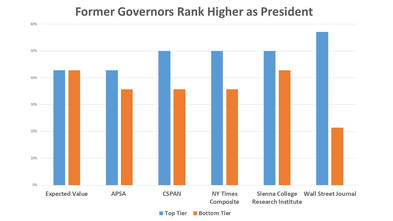
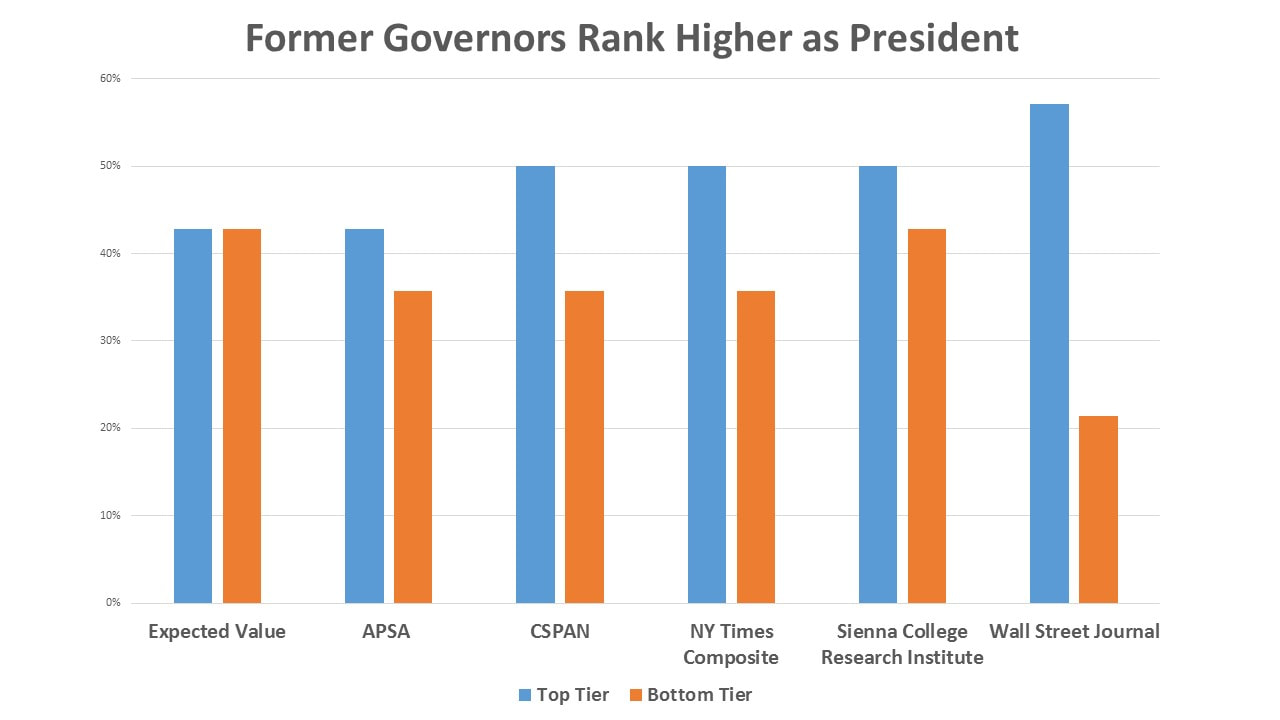
Historically, the single experience factor I found most likely to result in a top-tier president is prior experience as governor of a state or territory.  The pool of presidents I considered included 18 former governors—that is 42 percent of the 42 men who have served as chief executive prior to President Obama.  However, the percentage of top-tier presidents with prior service as governors was greater than 42 percent in three of four surveys.  If serving as a governor before becoming president did not affect performance as commander in chief, we would expect to find six prior governors in both top and bottom tiers.  However, each of three rankings—the New York Times composite, the CSPAN ranking, and the Sienna College Research Institute ranking—all had seven former governors in the top tier.  Only the American Political Science Association ranking had the expected value of six former governors in the top tier.  Not only did prior experience as a governor make it more likely for past presidents to be top-tier, but three of four surveys also showed that presidents with prior experience as governors were less likely to be ranked in the bottom tier of all presidents than we would expect if governorship was a performance-neutral factor.  Three surveys (NYT, APSA, and CSPAN) had five former governors in the bottom tier of presidents, while the Sienna College Research Institute ranking had the expected value of 6 former governors in the bottom tier.  We might infer from this historical data that candidates with experience as governors are more likely to perform better than average while in office.

The exact opposite correlation holds for presidents who had prior experience as Members of Congress (either House, Senate, or both) without experience as a governor.  The pool of presidents includes 23 former Members of Congress—that is 55 percent of the 42 men who have served as president through George W. Bush.  If prior service as a Member of Congress was a performance-neutral factor, we would expect to find eight former Members of Congress in both top and bottom tiers—eight is the whole number closest to 55 percent of 14.  However, only seven former Members of Congress appeared among the top-tier presidents in three rankings (NY Times Composite, CSPAN, Sienna College Research Institute).  A fourth survey (American Political Science Association) had only six former presidents with prior service as a Member of Congress in the top tier.   In addition, former Members of Congress were far more likely to appear in the bottom tier of presidents than we would expect if congressional experience was a performance-neutral factor.  All four surveys had more than eight bottom-tier presidents with prior experience in Congress.  In fact, three rankings (New York Times, American Political Science Association, Sienna College Research Institute) list 10 former Members of Congress in the bottom tier of presidents.  The CSPAN survey lists nine former Members of Congress among the 14 lowest-ranked presidents.  The fact that prior service in Congress carries a negative correlation for top-tier performance and an even stronger positive correlation for bottom-tier performance in the historical pool of presidents seems to imply that candidates with prior service in Congress (and no experience as governor) are more likely to be below-average performers as president.

These results have practical significance.  As we prepare to start thinking about the 2020 presidential election, it is appropriate for both parties to look for candidates who have experience as governors.  It is hard to imagine the board of directors of any major corporation choosing a chief executive without serious consideration of that executive’s past experiences and performance.  Indeed, many corporations structure the careers of rising stars to create a pool of candidates with specific job experiences that correlate with success in the chief executive role.  It is appropriate, then, for us to consider the correlations between experience factors and performance rankings among past presidents as we look to choose our next one.

[1] APSA, 2014; http://brook.gs/1AL8gcA.
2 CSPAN, 2009; "C-SPAN Survey of Presidential Leadership".
3 NYT, 2013; Silver, Nate (2013-01-23). “Contemplating Obama’s Place in History, Statistically.” The New York Times. http://nyti.ms/1Qnbfdj; The composite poll referenced in Silver’s article may be viewed at http://en.wikipedia.org/wiki/Historical_rankings_of_Presidents_of_the_United_States.`
4 SCRI, 2010; Thomas, G. Scott (2010-07-01). “Clean Sweep for the Roosevelts.” Business First of Buffalo. http://bit.ly/1Qma1ig;
5 WSJ, 2005; Taranto, James, “Presidential Leadership:  How’s He Doing?” The Wall Street Journal, Sep 12, 2005. http://bit.ly/1KKKvVD
6 Grover Cleveland served 2 non-consecutive terms as the 22d and 24th president.  Therefore, although President Obama was the 44th president, he was only the 43d person to hold the office.

0 Comments

If you're Buying the "Deep State" Conspiracy Theories, It's Time to Think Again...

4/8/2018

0 Comments

 
Picture
William of Ockham was a 14th-century Christian cleric and philosopher.  He is famous for formulating a "rule of thumb" that is known as Ockham's Razor.  The rule is simply this:  if you have to choose between theories, you should choose the theory that relies on the fewest assumptions.  That seems like common sense.  Assumptions are substitutes for facts--our best guesses that we use to fill in the blanks where we don't have facts.  It seems pretty reasonable to say that the theory with the most facts and the fewest assumptions, wins.

That is especially true when you consider that, if you are willing to make enough assumptions, you can choose to believe just about anything.  And your belief will be "unfalsifiable".  Because as soon as anyone presents you with evidence that your belief is false, you will simply introduce another assumption--an ad hoc hypothesis--to explain away the evidence that has been presented.

So let's consider all of the recent conspiracy theories about the Justice Department and the intelligence community. Robert Mueller's investigation has produced nearly 20 indictments, including 13 Russians accused of espionage.  These indictments are approved by a grand jury.  A grand jury is 16 to 23 Americans chosen for jury duty just like what happens in your home town.  And on a grand jury, 3/4 of the total number of jurors have to approve an indictment before it is handed down.  Mueller's investigation has also produced several guilty pleas from Americans who worked on the Trump campaign or transition team.  These people have confessed to lying about their contacts with Russians. Just last week, one of them was sentenced to serve time in jail for perjury.  In response to this, and in spite of the fact that the Special Counsel is a Republican, conservatives assert that the American justice department and intelligence community are engaged in a politically-motivated conspiracy to attack and undermine President Trump.

Contrast this investigation with the many investigations that occurred in the Obama administration.  There was a steady stream of investigations, including the Special Committee on Benghazi, which holds the record for the longest congressional investigation in our history.  Yet those investigations did not produce a single indictment or guilty plea.  And even in the fifteen months since the Republicans have gained control of the Executive Branch, there are no charges, no indictments, no guilty pleas.

So we are confronted with two hypotheses.  On the one hand, we can accept the facts at face value.  Assuming that the system of procedural justice has been applied uniformly in both cases, the difference in outcomes is a reflection of real wrongdoing on the part of the Trump campaign and transition team and the absence of wrongdoing on the part of the Obama administration.  On the other hand, we can start adding "ad hoc hypotheses" to explain why there are tangible results from the current Special Counsel's investigation and no tangible results from the many investigations during the Obama administration.  We can assume that Republicans and Democrats in the Justice and intelligence communities conspired to protect President Obama and Hillary Clinton several years before Donald Trump decided to run for President.  Oh yeah, and all of the press except Fox News was in on it, too.  We can further assume that these diverse conspirators also decided to attack and undermine an administration of the opposite party once Trump was elected. These are all ad hoc hypotheses. If there was evidence of a "deep state" conspiracy, the Republican Attorney General could produce his own indictments.

I know what William  of Ockham would say!!

0 Comments

Why Don't We Elect Presidents with the Best Qualifications?

4/8/2018

0 Comments

 
Picture
As the executive with responsibility for the people systems at internet retailer Overstock.com, my job included responsibility for developing current talent to meet the challenges of tomorrow.  In other words, I built systems to educate and train company workers so that they would be prepared for positions of greater responsibility.  This, of course, is one of the core functions of human resources in any organization.  Great business organizations have great systems for retaining and developing their best and brightest to face the challenges of tomorrow. 

Last week, as I completed the 45-day series of accountabilitycitizenship.org blogs on each of our presidents, I was reminded that the historical record tells us about the job experience factors most likely to correlate to good performance as president.

This blog, first published in an AccountabilityCitizenship.org newsletter in 2015, compares experience factors—jobs held before becoming president—with five different rankings of the 42 presidents through George W. Bush.  The goal is to identify specific job experiences that correlate with better or worse performance as president.  Scholars may squabble over whether Roosevelt or Reagan was the better communicator, but there is no dispute over the fact that both were governors before they became president.   Furthermore, most sources agree on the general ranking of presidents.  In other words, even though scholars may disagree on the exact rank of individuals within the list of all presidents, there is significant consensus on who is in the top and bottom 14.  Using five different rankings from distinct organizations provides some mitigation for the inevitable differences between rankings. The rankings used here are from the American Political Science Association (APSA) [Note 1], CSPAN [2], the New York Times (NYT [3], the Sienna College Research  Institute (SCRI) [4], and the Wall Street Journal (WSJ) [5]. 

When I first published this blog in 2015, I chose to exclude President Obama from the set of presidents used for this analysis because he was still in office.  This administrative move also left a pool of 42 past presidents—three equal tiers of 14 former chief executives.  Using a pool of presidents that breaks down into three equal tiers simplified the statistical analysis across surveys without materially changing the results.  

Of the 42 men who had held the office of President of the United States through President George W. Bush, 30 have been college graduates.  Twenty-eight have been veterans of military service.  Twenty-three served in one or both houses of Congress before becoming president.  Twenty-two have studied or practiced law.  Eighteen served as governors of states or territories.  Fourteen held cabinet posts, 12 were general officers, and eight were ambassadors.  We might expect these factors, or, in some cases, combinations of factors, to have affected the quality of job performance as president.   

I determine if there is a correlation between a factor and performance by first calculating the percentage of presidents who share a particular factor or combination.  For instance, as stated above, 30 of the presidents preceding President Obama have been college graduates, and 30 is 71 percent of the 42 presidents in this analysis.  If graduating from college has no correlation to performance, we would expect 71 percent of the top, middle and bottom tiers of the population of presidents to be college graduates.  Specifically, 71 percent of the 14 presidents in both the top and bottom tiers yields 9.9.  Since it makes no sense to speak of a fraction of a president, I round up to get the expected value of ten college graduates in each tier.  A positive correlation to any tier means a higher-than-expected number of presidents in that tier are college graduates.  A negative correlation means a lower-than-expected number of presidents in that tier are college graduates.

Correlation is not causation.  To say a positive correlation exists between a factor and a ranking does not mean the factor causes the ranking.  A positive correlation may mean that a particular factor makes a ranking more likely.

At this point, the analysis is simply a factual discussion of correlations between experience factors and performance rankings within the group of past presidents.  The claim that these historical correlations are likely to hold in the future is an example of inductive reasoning.  Inductive reasoning can only establish that an outcome is more or less likely.  It does not imply that any future outcome is certain.  We use this type of reasoning all the time, however, to make decisions about what we will do in the future.  In the financial sector, the standard disclaimer that “past performance is not a guarantee of future results” does not keep us from using past performance as one of our decision factors for how to invest.  In a similar fashion, the correlations discussed here should be considered but one factor in a comprehensive evaluation of candidates. 

Historically, the single experience factor I found most likely to result in a top-tier president is prior experience as governor of a state or territory.  The pool of presidents I considered included 18 former governors—that is 42 percent of the 42 men who have served as chief executive prior to President Obama.  However, the percentage of top-tier presidents with prior service as governors was greater than 42 percent in three of four surveys.  If serving as a governor before becoming president did not affect performance as commander in chief, we would expect to find six prior governors in both top and bottom tiers.  However, each of three rankings—the New York Times composite, the CSPAN ranking, and the Sienna College Research Institute ranking—all had seven former governors in the top tier.  Only the American Political Science Association ranking had the expected value of six former governors in the top tier.  Not only did prior experience as a governor make it more likely for past presidents to be top-tier, but three of four surveys also showed that presidents with prior experience as governors were less likely to be ranked in the bottom tier of all presidents than we would expect if governorship was a performance-neutral factor.  Three surveys (NYT, APSA, and CSPAN) had five former governors in the bottom tier of presidents, while the Sienna College Research Institute ranking had the expected value of 6 former governors in the bottom tier.  We might infer from this historical data that candidates with experience as governors are more likely to perform better than average while in office.

The exact opposite correlation holds for presidents who had prior experience as Members of Congress (either House, Senate, or both) without experience as a governor.  The pool of presidents includes 23 former Members of Congress—that is 55 percent of the 42 men who have served as president through George W. Bush.  If prior service as a Member of Congress was a performance-neutral factor, we would expect to find eight former Members of Congress in both top and bottom tiers—eight is the whole number closest to 55 percent of 14.  However, only seven former Members of Congress appeared among the top-tier presidents in three rankings (NY Times Composite, CSPAN, Sienna College Research Institute).  A fourth survey (American Political Science Association) had only six former presidents with prior service as a Member of Congress in the top tier.   In addition, former Members of Congress were far more likely to appear in the bottom tier of presidents than we would expect if congressional experience was a performance-neutral factor.  All four surveys had more than eight bottom-tier presidents with prior experience in Congress.  In fact, three rankings (New York Times, American Political Science Association, Sienna College Research Institute) list 10 former Members of Congress in the bottom tier of presidents.  The CSPAN survey lists nine former Members of Congress among the 14 lowest-ranked presidents.  The fact that prior service in Congress carries a negative correlation for top-tier performance and an even stronger positive correlation for bottom-tier performance in the historical pool of presidents seems to imply that candidates with prior service in Congress (and no experience as governor) are more likely to be below-average performers as president.

These results have practical significance.  As we prepare to start thinking about the 2020 presidential election, it is appropriate for both parties to look for candidates who have experience as governors.  It is hard to imagine the board of directors of any major corporation choosing a chief executive without serious consideration of that executive’s past experiences and performance.  Indeed, many corporations structure the careers of rising stars to create a pool of candidates with specific job experiences that correlate with success in the chief executive role.  It is appropriate, then, for us to consider the correlations between experience factors and performance rankings among past presidents as we look to choose our next one.

[1] APSA, 2014; http://brook.gs/1AL8gcA.
2 CSPAN, 2009; "C-SPAN Survey of Presidential Leadership".
3 NYT, 2013; Silver, Nate (2013-01-23). “Contemplating Obama’s Place in History, Statistically.” The New York Times. http://nyti.ms/1Qnbfdj; The composite poll referenced in Silver’s article may be viewed at http://en.wikipedia.org/wiki/Historical_rankings_of_Presidents_of_the_United_States.`
4 SCRI, 2010; Thomas, G. Scott (2010-07-01). “Clean Sweep for the Roosevelts.” Business First of Buffalo. http://bit.ly/1Qma1ig;
5 WSJ, 2005; Taranto, James, “Presidential Leadership:  How’s He Doing?” The Wall Street Journal, Sep 12, 2005. http://bit.ly/1KKKvVD
6 Grover Cleveland served 2 non-consecutive terms as the 22d and 24th president.  Therefore, although President Obama was the 44th president, he was only the 43d person to hold the office.

0 Comments

Donald Trump, 45th President of the United States (2017-?)

4/4/2018

0 Comments

 
Picture
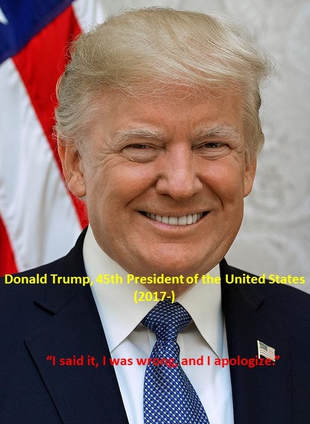
Donald Trump defeated Hillary Clinton in the 2016 general election by a margin of 305 electoral college votes to 232 electoral college votes. Trump became the fifth president in our history to win the electoral college (and thus the presidency) while losing the popular vote--Clinton won the popular vote by about 3 million votes.

​I have a West Point classmate who wrote a book to explain why he voted for Donald Trump.  I read the book to try to understand the point of view of Trump supporters.  I also listened to a number of other friends--staunch Republicans--who also voted for Trump.  The best argument in support of President Trump from these people is this:  (1) our government is a mired bureaucracy in need of a disruptive change agent who is an outsider to the political process to reform it, and to make America great again.  (2) Donald Trump is a disruptive change agent who is an outsider to the political process and will reform it.  (3) Therefore, we should vote for and support President Trump. (4) Any opposition to President Trump is a manifestation of the entrenched bureaucracy and not an accurate reflection of Trump's flaws. While I accept the first premise, I cannot accept any of the others.

On the other side of the ledger--the side of those of us who find President Trump to be unfit for the office of President--I find the most problematic character flaw of our current President is his constant attack on the free press and his use of the bully pulpit to broadcast propaganda and falsehoods.  The Washington Post reported in November, 2017, that President Trump had made 1,628 false or misleading statements over a period of 298 days.  In response, Trump and his supporters simply claim any news they do not like is "fake news," and have labelled legitimate media outlets as "enemies of the people." However, there are time-tested standards for determining what is true and what is false, and these standards show that Trump and his supporters are wrong. The Washington Post is a credible newspaper.  It is not the National Enquirer.  The difference between the two is simple:  the Washington Post follows the time-tested standards for establishing what is true and what is false--and the National Enquirer does not follow those standards.

We at accountabilitycitizenship.org will continue to explore and explain the correspondence theory of truth and the coherence theory of truth in upcoming blogs, as we have in past blogs.  We will explore and explain Occam's Razor, ad hoc hypotheses, and the notion of predictability.  With these tools, and a commitment to diversify your sources of information, you can establish for yourself what is true and what is fake news.  This is an essential skill, and it starts with your commitment to diversify your sources of information.

​I close with this thought--whether or not you or President Trump likes a statement or premise has nothing to do with whether that statement or premise is true.  Take, for instance, the assertion that, at one atmosphere of pressure, water will turn to ice at 32 degrees Fahrenheit.  You may hate that, and you may rant and rave about how it is "fake news."  But I will still be able to take a jar of water, put it at one atmosphere of pressure and 32 degrees Fahrenheit, and it WILL turn to ice.  I can predict that it will do so tomorrow as well, and then repeat the experiment with the same predictable result.  While not all matters will be as clear as proving a scientific fact, this simple example shows how you can use principles of correspondence, coherence, predictability and simplicity--we will explore these ideas in greater detail in the days ahead. 

​The US intelligence community published an unclassified assessment in January of 2017 that asserted Russia made a major strategic effort to disrupt the 2016 election in the United States.  The Special Counsel's investigation has since confirmed that to be true, indicting 13 Russians for their role in that effort.  Furthermore, numerous members of the Trump campaign staff, up to and including one of Trump's campaign managers, have been indicted or have plead guilty to charges of lying about the campaign's communications and contacts with Russia during the election and during the transition period.  One former Trump campaign staffer was convicted and sentenced to jail time this past week.  There is clear evidence that the President has attempted to interfere with the investigation.  So far, however, no public evidence establishes a direct connection between the president and the efforts of his indicted staff members.  But if Donald Trump were working to help the Russians disrupt the next American election, one of the most important things he could do would be to undermine the faith of the American people in their free press--their sources of information.  And that is exactly what he seems to be doing.

"Were it left to me to decide whether we should have a government without newspapers, or newspapers without a government, I should not hesitate a moment to prefer the latter. "  Thomas Jefferson


0 Comments

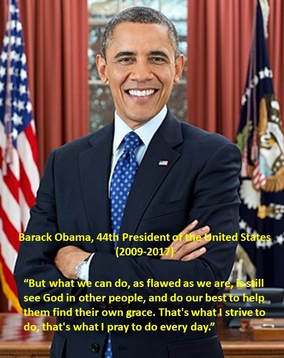
Barack Obama, 44th President of the United states (2009-2017)

4/3/2018

0 Comments

 
Picture
Barack Obama was the first African American elected to be President of the United States, winning the 2008 general election over Senator John McCain.  President Obama had 365 electoral college votes to Senator McCain's 173, and he won the popular vote by a margin of nearly 10 million votes.  President Obama was re-elected in 2012, defeating Governor Mitt Romney by a margin of 332 votes to 206 in the electoral college, and winning the popular vote by just over 5 million votes.

​President Obama was sworn into office at the height of the Great Recession, the greatest global recession since the Great Depression of the 1930s.  The recession began in the United States with a crisis related to subprime mortgages and speculative investment vehicles tied to those mortgages.  Within a month, Obama signed into law the American Recovery and Reinvestment Act of 2009, providing nearly $800 billion in government stimulus spending.  Within a few months, the government set aside trillions more to buy up distressed real estate assets and to rescue failing automobile manufacturers.  By June of 2009, the National Bureau of Economic Research declared the recession over, though it would take much longer for the economy to recover.  By the end of Obama's presidency,  the unemployment rate had dropped from a high of nearly 10 percent to 4.7 percent.

​By the end of his second year in office, President Obama achieved the most comprehensive reform of the American health system since the expansion of Medicare and Medicaid under President Johnson.  At the time of its passage, the so-called Patient Protection and Affordable Care Act (PPACA), quickly dubbed "Obamacare", expanded coverage to 24 million of the 50 million Americans without insurance, and was scored by the Congressional Budget Office as reducing the federal debt over ten years.  Ironically, Obamacare incorporated Republican-backed elements that had succeeded under Governor Mitt Romney in Massachusett's health care plan.  It included a requirement for individuals to have health insurance--the individual mandate--that was first proposed by Republican Senator Orrin Hatch in 1993 as an alternative to the health care reforms proposed by the Clinton administration.  Tragically, the fact that the ACA included elements that had Republican support in other times and places did not prevent the initiative from falling prey to a prolonged and comprehensive attack by Republicans in Congress.  The plan hurt small businesses, was poorly implemented in many ways, and was opposed by a massive health care lobby newly empowered by the Supreme Court's relaxation of lobbying restrictions (Citizens United v. FEC).  Though consistently supported by a plurality of Americans, the law provoked a massive backlash that led to the Republicans regaining control of Congress.  Rather than fixing its flaws, Congress has largely gutted the law in the eight years since its passage.

0 Comments

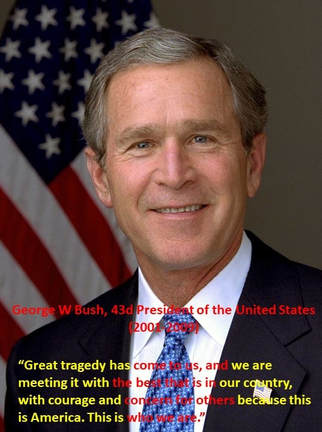
George W Bush, 43d President of the U.S. (2001-2009)

4/2/2018

0 Comments

 
Picture
George W Bush won the 2000 election by the closest margin in history.  Although Benjamin Harrison had also become President by winning the electoral college while losing the popular vote, Harrison won the election of 1888 by 65 electoral votes.  George W Bush not only lost the popular vote to Al Gore, but he also won the electoral college by the slim margin of five (5) votes.  The vote was so close it came down to Florida, and that vote count was close enough to trigger first one recount and then another.  Meanwhile, procedural issues were litigated in the courts, and the Supreme Court ultimately decided the election by ordering the second recount stopped.

​However narrow the margin of his victory, George W Bush rallied the country in the wake of the 9-11 terrorist attacks that killed over 3000 Americans when terrorists hijacked four large commercial airliners and flew them into the World Trade Center in New York City and the Pentagon in Washington, DC.  The fourth plane, presumably supposed to hit the White House, crashed in a field in Pennsylvania when passengers attacked the hijackers.  The attacks on the World Trade Center were particularly horrific, with many of the people trapped in the upper floors forced to choose between burning to death or jumping to their death.  Many first responders were killed trying to rescue people trapped in the World Trade Center.  Hundreds more Americans were killed when the third plane crashed into the Pentagon.

​As details of the hijackers' preparations came to light, it was clear that this attack was planned far in advance, with the hijackers living in America for months and years before the attack, taking flight lessons in the communities where they lived, and even visiting their targets in order to program satellite navigation devices used in the attack.  The source of the attack was identified as the same terrorist organization that had attacked America and American interests around the world throughout the 1990's:  al Qaeda.  The leadership of this terrorist organization was operating from within sanctuary provided by the Taliban regime of Afghanistan.

​The United States and its allies began attacks against the Taliban regime in October, 2001, and had driven that regime from power and replaced it with a friendly regime by the end of the year.  A guerilla war ensued, and the Taliban proved resilient.  The war between the US backed government of Afghanistan and the Taliban continues to this day, with American forces still deployed in support of the current government.

​If the War on Terror presented the Bush administration with a serious challenge, the economy also presented its share of crises.  Bush took office amid a downturn attributed to the bursting of a tech bubble.  The economy recovered with increased government spending accompanying the War on Terror as well as deep tax cuts, with the Dow peaking over 14,000 in 2007.  Then, the Great Recession hit, sparked by the collapse of mortgage backed securities.  The Dow dropped by almost 50 percent, and the economy shed 8.7 million jobs.  Unemployment rose from about 4.7 percent in 2007 to about 10 percent in 2009.  The Great Recession was the worst economic crisis to hit the United States since the Great Depression of the 1930's

To George W Bush goes the ironic achievement of holding both the highest public approval rating in history (in the wake of the , 9-11 attacks) as well as the lowest approval rating in history (during the Great Recession).


0 Comments

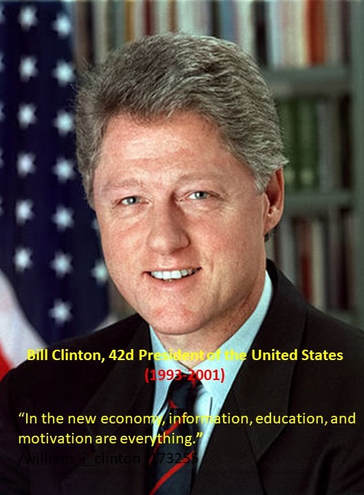
Bill Clinton, 42d President of the United States (1993-2001)

4/1/2018

2 Comments

 
Picture
The closer we get to the present day, the harder it will be for us all to keep our personal opinions about our presidents out of our comments.  I will do my best to stick to the facts of each president, but the choice between which facts to include and which to exclude always carries its own bias.  In light of this, it is fair for readers to understand that I try to choose facts that are (1) unique to a certain president, (2) representative of some significant statistic or trend (e.g., Kennedy was the fourth president to be assassinated), and (3) illustrative of principles I think are important for assessing the quality of a president's performance of duty.  

Bill Clinton was the first president since Woodrow Wilson to take office in a world where there was no Soviet Union.  That entity, the communist government that resulted from the Russian Revolution, collapsed in 1989, and the United States was left as the pre-eminent global superpower.  This fact allowed the US government to cut military spending--the largest single piece of the discretionary budget--by about a third during the Clinton presidency.  That is not to say the military was idle during Clinton's presidency:  there was an ongoing operation to enforce no-fly zones over significant areas of Iraq, a deployment to Somalia to rescue a failed state that brought American forces into direct combat against the kind of unconventional adversaries that we have been fighting ever since, and deployments to the Balkans to stabilize areas where the vacuum created by the Soviet collapse led to civil war and genocide.  That said, the absence of a peer competitor took some pressure off the budget.  By the end of Clinton's second term, the Congressional Budget Office had reported three years in a row with a budget surplus.  Before 1998, the last budget with a surplus had been 30 years previously--in 1969.

​Clinton's second term was consumed with a scandal stemming from sexual misconduct by the president with a young intern named Monica Lewinsky.  in 1998, Clinton was impeached by the House of Representatives and tried by the Senate for charges of perjury and obstruction of justice.  After a 21-day trial, Clinton was acquitted on both charges because the Senate could not reach the two-thirds majority required to convict and remove and office holder.  The final votes were close and largely decided along party lines.

​Throughout all of this controversy, the economy was largely a good-news story during the Clinton years.  The private sector was consumed with the explosion of information technology and the need to patch systems to prevent a serious interruption at the turn of the century--the so-called Y2K problem.  There was a bit of a downturn at the end of Clinton's presidency as a bubble of tech company stocks burst, but otherwise the Clinton economy was a strong economy.

Finally, there was a steady drumbeat of terrorist attacks during the Clinton presidency.  Many of these attacks were linked to a terrorist group known as al Qaeda.  There was a first attempt to destroy the World Trade Center with a truck bomb in 1993 that killed several Americans, followed by a bombing of US barracks in Saudi Arabia, a bombing of our embassies in Africa, a bombing of the USS Cole that killed seventeen sailors, and an assassination attempt against Clinton in the Phillipines that has only recently been made public.

​In general, despite the positive economy, the Clinton presidency was accompanied by an increased level of partisanship that has been a factor in the American political scene ever since.*

​*This is my observation.  Do you agree?  Please comment.  In any event, it is an observed correlation.  I do not know if there is a causal connection.  Do you remember the difference between correlation and causation?
​ 

2 Comments
Forward>>
    Picture

    Author

    Author of What Makes a Great President?, Close Encounters With Accountability Citizen-ship, Thy King Dumb Come, & Accountability Citi-zenship, Stephen P. Tryon is a businessman & technologist with extensive experience in e-commerce, a retired Soldier, and former Senate Fellow.

    Register to Win Cool Stuff!

    Archives

    February 2026
    January 2026
    December 2025
    November 2025
    October 2025
    September 2025
    August 2025
    July 2025
    May 2025
    March 2025
    February 2025
    January 2025
    November 2024
    October 2024
    September 2024
    January 2024
    August 2023
    June 2023
    May 2023
    February 2021
    January 2021
    December 2020
    November 2020
    October 2020
    July 2020
    June 2020
    May 2020
    March 2020
    February 2020
    January 2020
    December 2019
    November 2019
    October 2019
    September 2019
    August 2019
    July 2019
    June 2019
    May 2019
    April 2019
    March 2019
    February 2019
    January 2019
    December 2018
    November 2018
    August 2018
    July 2018
    June 2018
    May 2018
    April 2018
    March 2018
    February 2018
    January 2018
    July 2017
    May 2017
    February 2017
    December 2016
    November 2016
    May 2016
    March 2016
    November 2015
    October 2015
    September 2015
    August 2015
    July 2015

    Categories

    All

    RSS Feed

    View my profile on LinkedIn
Proudly powered by Weebly